
„Cash cows“. Kriegsmarine submarine tankers.
In December 1941, with the entry of the United States into the war, the German command lifted the ban on the operation of submarines in American waters. In the course of Operation Paukenschlag (Drumroll), a group of five ocean-class submarines was sent to the Western Atlantic, which still had weak anti-submarine defenses. Subsequently, the number of submarines was increased, but never exceeded twelve combat units in combat Duty. The priority targets for German submariners were tankers transporting oil and petroleum products from the south of the United States to the east coast of the country.
Due to the remoteness of the area of operations, the basis of the German strike forces in the region was made up of ocean-going submarines of the „IX“ series, which had an increased supply of fuel. Each submarine carried 22 torpedoes of 533 mm caliber, and was also equipped with a 105 mm universal gun, which was successfully used against unarmed merchant ships.
The main problem faced by the German submariners was the relatively short time of combat duty. Despite various tricks, the lion’s share of resources and fuel was eaten up by the passages to combat patrol areas and back to base.
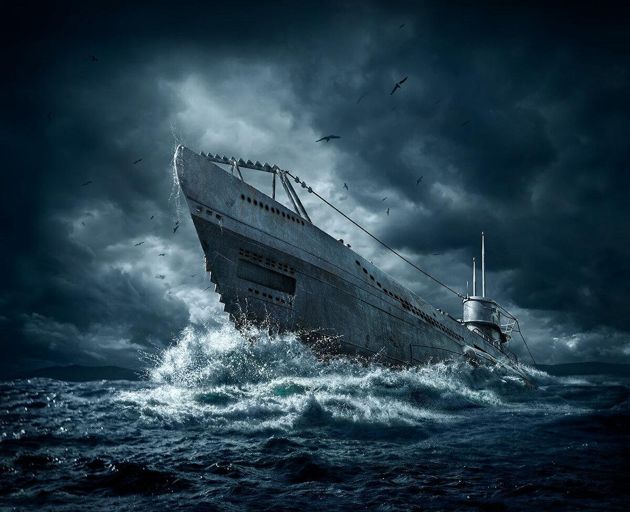
A fine example of a diorama showing the difficulties of long journeys.
When crossing the Atlantic Ocean, the submarines‘ mechanical engineers resorted to frequent maneuvers and changes in the mode of operation of the engines in order to reduce fuel consumption. During severe storms, the boats sank. Under water, they went slower, but again they saved fuel. On submarines, some tanks intended for drinking and technical water were filled with fuel. Submariners gave up basic amenities in order to fill the boat to the brim with provisions, spare parts and materials necessary to increase the autonomy of navigation.
The submarines had extremely poor habitability, as they were built on the principle of maximum use of each ton of displacement to increase the combat qualities of the boat. However, even in such conditions, the crews often refused everything that could be called „comfort“. Everything needed was loaded even beyond the permissible limits. The beds had been occupied by boxes of food for weeks. In the overcrowded compartments, only narrow passages remained. Some captains got so carried away that they went beyond the limits of safety in this matter, which is why the command of the submarine forces was forced to give appropriate restrictive orders.
Thanks to the submariners‘ experience and tricks, the range of submarines‘ cruises turned out to be actually more than calculated. However, the time of combat duty in patrol areas for large displacement submarines still did not exceed three weeks (and for medium submarines of the „VII“ series it was even less). To solve this problem, the Kriegsmarine command ordered the construction of several supply submarines.
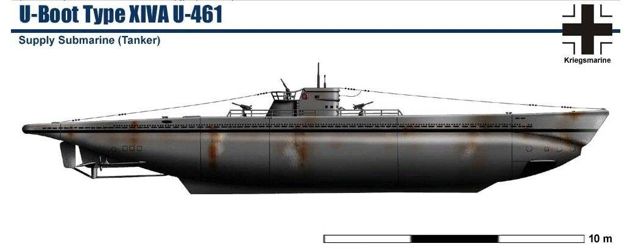
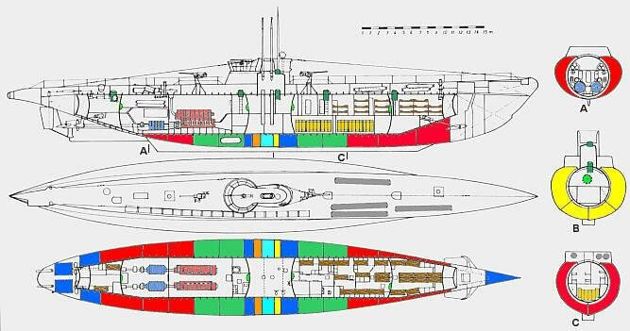
The submarine tanker „XIV“ series was a rather successful attempt at a deep modernization of the large ocean-going boats of the „IX“ series. The submarine was a specialized supply vessel designed to replenish submarines on combat duty, far from anchorages and naval bases. With fuel supply at the forefront, the submarine tankers earned the unofficial apt nickname „Milchkühe“ („Milchkühe“).
The length of the submarine was 67.1 m, the width was 9.35 m, the height was 11.7 m. Displacement surface/underwater 1688 / 1932 tons. The submarine was powered by two diesel engines with a total capacity of 3,200 hp. When submerged, propulsion was provided by two electric motors with a total power of 750 hp. Propulsion systems allowed the boat to reach speeds of up to 15 knots (28 km/h) on the surface and about 6 knots (11 km/h) submerged. The economic cruising range was 22,870 km on the surface and 220 km when diving. The boat was capable of operating at depths of up to 240 meters. The submarine had no torpedo tubes and no deck gun. As defensive weapons, one 20 mm and two twin 37 mm anti-aircraft guns were installed on board. The submarine had a crew of 60 men.
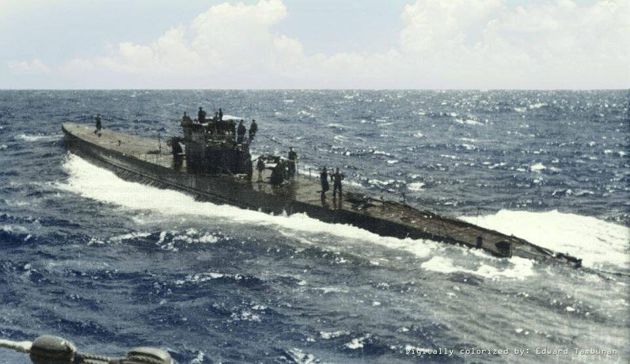
The first submarine tanker „U-459“ („Cash Cow“) on the voyage.
The „cash cow“ took 700 tons of fuel. Depending on the length of stay at sea, she could give combat submarines from 400 to 600 tons. This fuel was enough to support the combat activities of twelve medium submarines of the VII series (50 tons each) located in remote areas of the Caribbean Sea, or five ocean-going submarines of the large displacement of the IX series (90 tons each) near the Cape of Good Hope. On average, the transfer of fuel provided an additional two weeks of combat duty.
In addition, the submarine could replenish the reserves of engine oil (up to 13 tons), fresh food, which were stored in refrigeration units and torpedoes, in the amount of 4 units. The boat was equipped with a bakery and provided the combat crews on the campaign with such luxuries as fresh bread. A first-aid post with several beds was deployed on the submarine for the evacuation of wounded sailors. There was even a small guardhouse for transporting prisoners and German sailors to Germany.
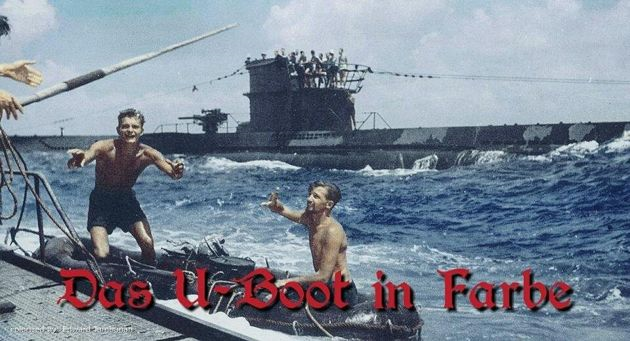
Supply boats operated in the mid-Atlantic, rendezvous away from Allied anti-submarine patrols and aircraft. Resupply and refueling operations often took several hours, putting both the Cash Cow and the submarine it was servicing at risk. The cargoes were transported with the help of a 6-meter inflatable boat, as well as using reloading cranes. The flat main deck of the tanker was equipped with technological hatches to facilitate the transportation of bulk cargo. However, in the conditions of the North Atlantic, the hull was often flooded by high waves. Supplies had to be lifted manually through the hatch of the conning tower, and it was impossible to store cargo on deck.
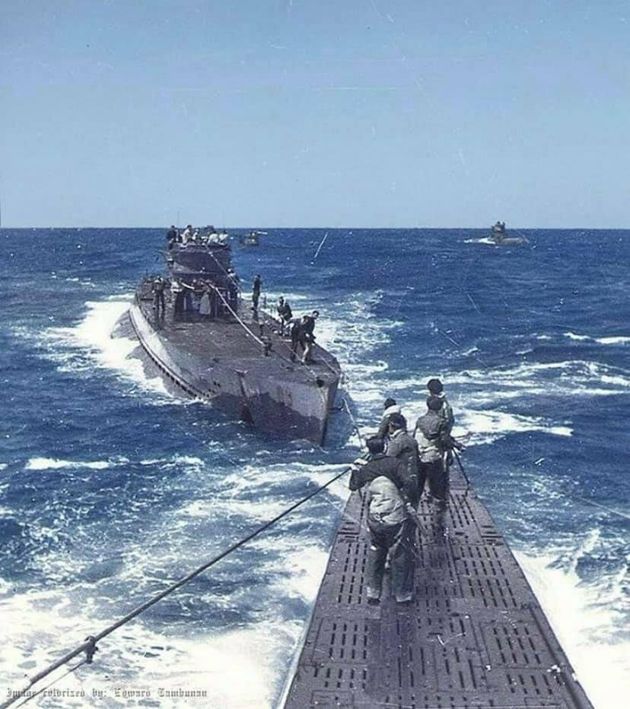
Meeting of the submarine tanker „U-462“ („Cash Cow“) under the command of Lieutenant Bruno Vove with the combat submarines „U-755“, „U-373“, „U-569“ and „U-135“ in the North Atlantic, 06.09.1942
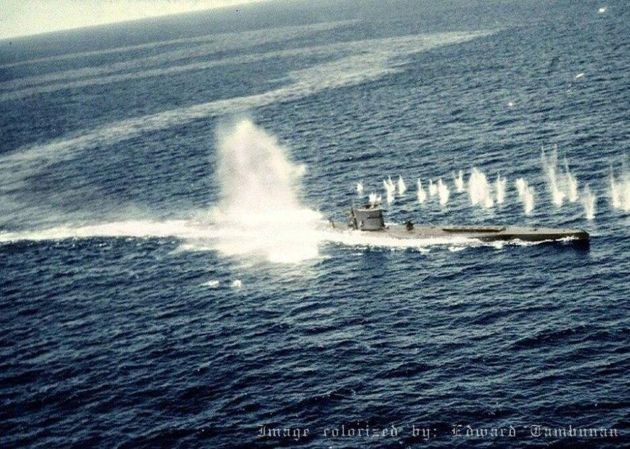
Sometimes, due to bad weather, the intake of fuel from the submarine tanker was interrupted, the transfer of cargo was delayed. As a result, several submarines gathered near the Cash Cow, waiting for their turn. Such a concentration of submarines was fraught with danger and always caused alarm among the German command. In the event that the Germans came under air raid during resupply, the clumsy submarine tanker was the first to go deep. The rest of the submarines covered the submarine with fire for some time, remaining on the surface.
U-118 under attack from the escort carrier Bogue.
On April 22, 1942, the submarine U-459 transferred fuel to U-108 for the first time in an area 500 miles northeast of Bermuda. Two weeks later, twelve more medium submarines and two large submarines took fuel from U-459 in the same area.
From late April to mid-June 1942, the tanker submarines U-459, U-460 and U-461 supplied 37 submarines that alternately fought in American waters, which had an immediate impact on the course of the fighting. Over the same period, in the Caribbean alone, 148 Allied ships with a total tonnage of 752,009 guns were sunk by German submariners. Reg. Tons.
Naturally, the Cash Cows became priority targets for Allied attacks, as the sinking of one submarine drastically reduced the capabilities of the German U-boat force and forced the attack submarines to return to their bases ahead of time to replenish fuel and supplies.
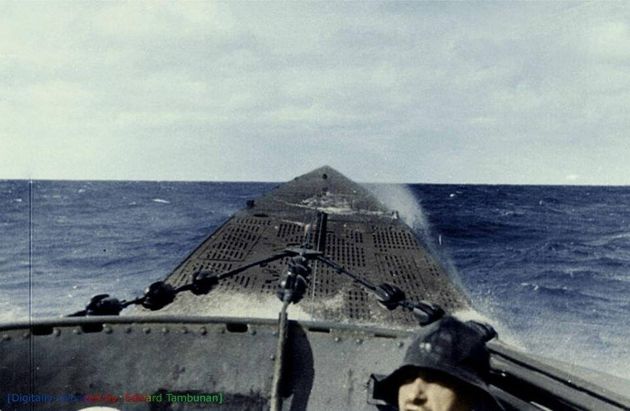
Underwater tanker „U-459“ („Cash Cow“) on the voyage.
The discovery of the German naval code allowed the Allies to obtain information about the routes and rendezvous points of the submarines. And the strengthening of anti-submarine defense and the appearance of more advanced technical means of detecting submarines did not leave any chance for German submariners. During 1943, the Allies managed to destroy most of the submarines, and by the end of the war, all ten supply submarines had been sunk. It is believed that out of the total number of submariners who served on the „Cash Cows“ (530-576 people), 289 sailors died.