
„The New Religion of the USSR“: What the Soviet Authorities Wanted to Replace Orthodoxy
The Great Patriotic War was marked, on the one hand, by a patriotic upsurge in the USSR, and on the other hand, by a weakening of the pressure of the authorities on traditional confessions. But few people know that at the same time, a project of a new religion arose in the Soviet leadership, designed to replace official atheism – the „Cult of the Sacred Motherland“.
Sounds of „Holy War“
From the first days of the war, the official rhetoric of the Soviet government began to actively use sacred images and epithets. The land and borders of the USSR, its capital Moscow, and even „Lenin’s tomb,“ which were threatened with German conquest, were declared „sacred.“ The writer Alexei Tolstoy spoke of „sacred hatred“ of the enemy. The song „Holy War“, which sounded on the radio, touched the deep strings of the Russian soul, found a lively response from listeners. For example, on June 25, 1941, Nina Soboleva, a student of the Leningrad Theater Institute, wrote in her diary that this song gave her „goosebumps.“
In order to mobilize the population to defend the Fatherland, Stalin partially „rehabilitated“ Russia’s historical past. The names of Russian princes and tsarist generals were returned to the official heroic „pantheon“. The first signs of a „new deal“ with regard to religion also appeared.
All these trends unexpectedly found their logical conclusion in the head of the Moscow architect Andrey Chaldymov. This man was not some urban madman, but the rector of the Moscow Architectural Institute, i.e. he occupied not the last place in the Soviet social hierarchy. Chaldymov’s project of a new state religion of the USSR looked all the more bizarre.
Chaldymov’s Letter
In the summer and autumn of 1944, Andrei Chaldymov sent several letters to the addressees in the party leadership, including Joseph Stalin himself. The architect substantiated the idea of introducing the so-called „Cult of the Sacred Motherland“ into the USSR. In his opinion, the traditional forms of holding Soviet events no longer met the „increased requirements of the culture of our people.“
„We especially feel an acute lack of forms of expression of solemnly joyful and solemnly sad personal events in the life of citizens, the need for which is quite obvious,“ Chaldymov explained to the „father of nations.“ „At the same time, everyone knows the enormous power of influencing the feelings of participants in religious holidays and ceremonies, which could agitate a person, influencing his psyche with rich and diverse forms of worship.“
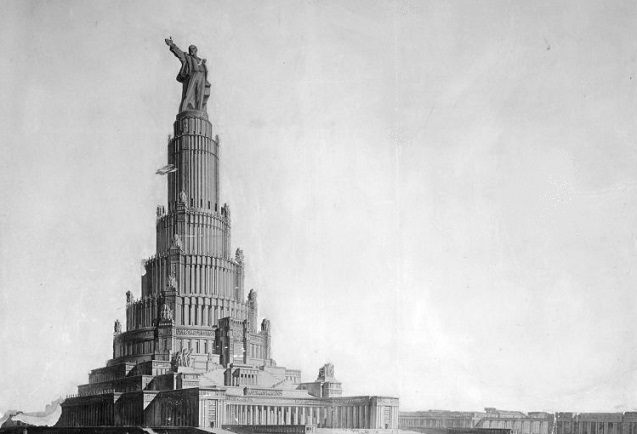
The rector of the Moscow Institute of Architecture proposed to build „a public structure for the spiritual life of the people“ – the Temple of the Holy Motherland. Inside, by means of painting and other types of art, Chaldymov planned to reflect „the great traditions of the people and, in particular, the heroics of the Patriotic War.“
The projector was going to develop the rituals of the new faith, introduce a calendar of festivities and create a list of Soviet „commandments“ related to the main issues of human existence. From Orthodoxy, the „Cult of the Holy Motherland“ was supposed to borrow the tradition of bell ringing.
The fate of the idea
Andrei Chaldymov assured Stalin’s secretary Alexander Poskrebyshev that Malenkov and Kaganovich were allegedly interested in his proposals. However, the members of the Central Committee (and perhaps the leader himself) apparently found the idea too exotic and did not receive any development. Nevertheless, after the war, Soviet society began to pay more attention to rituals, for example, the civil wedding ceremony was finalized. Other „demands of the culture of the people“ were replaced by the cult of personality of Stalin himself, which reached its peak in 1945-53.
It should be added that the idea of a religion based on patriotism was in the air in the middle of the 20th century, not only in Moscow. Nazi ideologue Alfred Rosenberg designed the „National Church of the Reich“ with Mein Kampf as „holy scripture.“ And among Ukrainian emigrants after World War II, the neo-pagan „Native Ukrainian National Faith“ spread. The cult center of this organization has an almost „Chaldymov“ name – „Temple of Mother Ukraine“ (Spring Glen, New York).