
The Nazis really considered the Gypsies to be descendants of the Aryans: why were they disliked then?
Nazi ideology denied the right to exist to entire nations, the so-called „non-Aryans.“ Not only Jews were exterminated, but also Slavs. The latter were called „subhumans“ („untermenshi“). The war against the Russians, the Poles and the Yugoslavs was waged for annihilation, and if for war crimes in Western Europe a German soldier was threatened with a tribunal, then for crimes in Poland, Yugoslavia or the USSR – absolutely nothing.
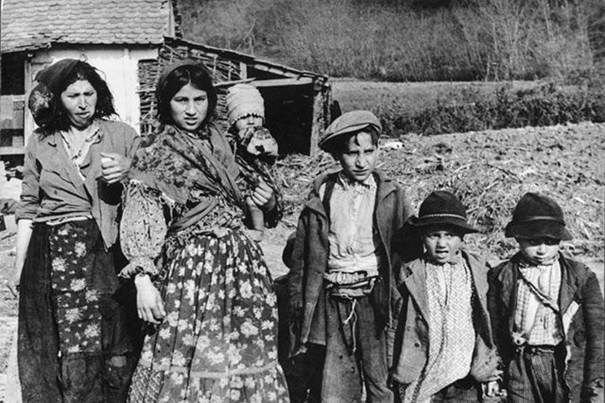
The Roma were also among the nations denied the right to exist. What was the reason for this, and why did Hitler consider the Roma a threat?
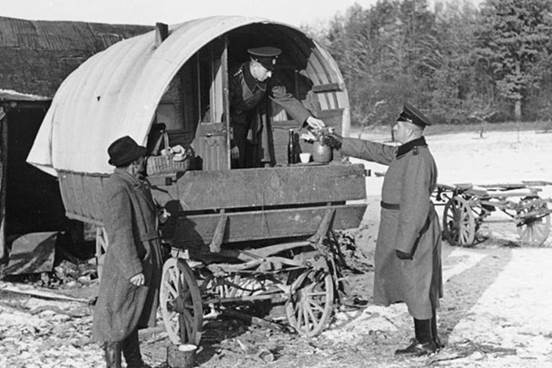
Anti-Gypsy raid. 1936
The „Racial Psychology“ of the Third Reich
Anti-Roma laws were passed in 1926 in Bavaria, seven years before the Nazis came to power. It was on him that the Nazi ideologues later relied. The law itself was referred to in official documents as the „Law on the Fight against Gypsies, Vagabonds and Parasites“.
Did the Nazis consider the Roma to be „a nation of thieves and vermin“? In fact, this is not the case – according to the Nazi racial theory, the Germans are the descendants of the Aryans, the Indo-European settlers, and they are the closest to the „true Aryans“. However, if we study the ethnogenesis of the Gypsies, the following picture emerges: most of the Roma are descendants of immigrants from India, which confirms the closeness of the Romal languages to the Indo-European ones. It turns out that the Gypsies are closer to the Aryans than the Germans.
The Nazis immediately corrected their theory, declaring that the Gypsies were the descendants of Aryans who had mixed with „inferior“ races. For this reason, they have an innate tendency to vagrancy, theft, and other crimes.
This theory was based on the so-called „racial psychologists“ – Robert Ritter and Eva Justin.
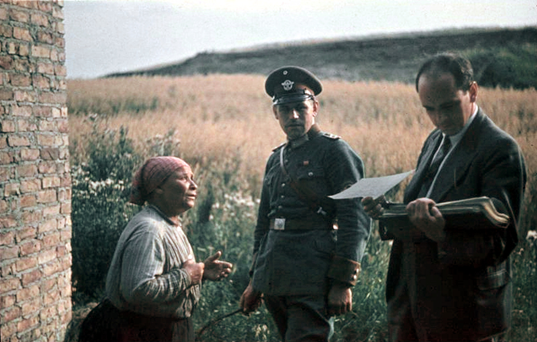
Robert Ritter, in the presence of a police officer, interrogates a gypsy woman. Digitized photo
Ritter’s assistant, in turn, wrote: „It is impossible to raise Gypsy children to be full-fledged members of German society, since they are characterized by natural laziness, feeble-mindedness, a tendency to vagrancy, incest and theft.“
Initially, the Nazis, relying on the experience of Bavaria, extended the law of 1926 to the rest of Germany, and from 1935 the mass deportation of Roma to special camps began.
In 1936, Roma were subject to the Nuremberg Laws on Nationality and Race, which stripped Roma of their citizenship, the right to vote, and strictly forbade them from marrying „Aryans.“ During holidays and various celebrations, all Gypsies, even sedentary ones, were forcibly deported outside the city. The deportation of Roma from Berlin during the Olympic Games was particularly widespread. The narrow wedge of land between the railway lines and the Marzan cemetery would later be called the „Marzahn Resting Ground“, where a total of about 1,500 Gypsies were deported, from where most of them were sent straight to concentration camps.
Soon after, Eva Justin published her doctoral dissertation, in which she argued for the need for a policy of „racial hygiene“ towards the Roma.
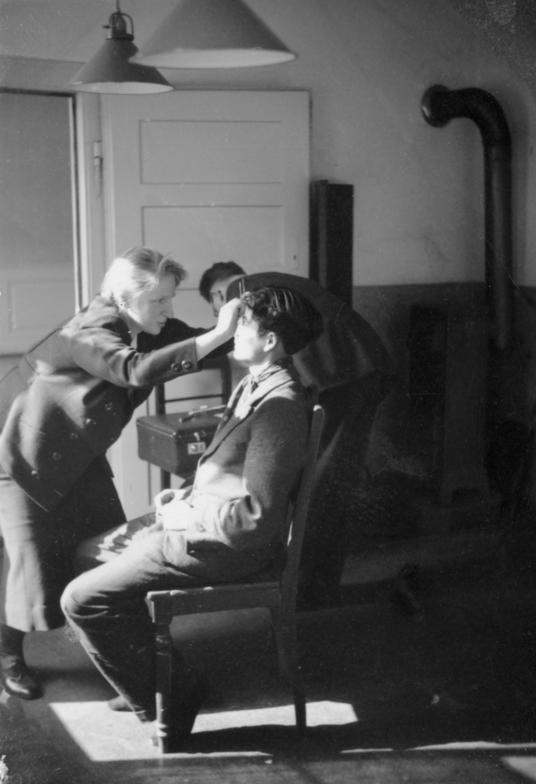
Eva Justin measures the skull of a gypsy teenager
This gave rise to a new law. In 1938, „in order to avoid the appearance of non-Aryan offspring“, the forced sterilization of Roma women began, to which not only adult women, but also girls were subjected.
However, all this was only a preparation for the open genocide that the Nazis would resort to when the war began.
Genocide of Roma in the Occupied Territories
On April 27, 1940, Roma began to be forcibly exiled to Poland and settled in Jewish ghettos. The purposeful extermination of the Roma began in the USSR and was carried out by punitive detachments and local collaborators.
Their satellites did not lag behind the Germans – in Romania and Hungary, the direct genocide of the Roma also began. They were sent to death camps, and sometimes simply shot, without even being brought to transit points and railway stations.
According to the most conservative estimates, 220,000 Roma were killed. The maximum figure is 1.5 million, taking into account the missing and those who died of exhaustion and hard labor.
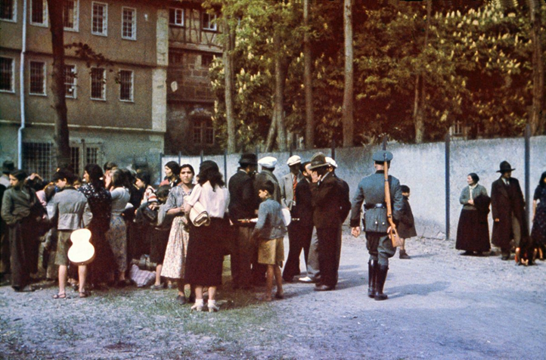
Gypsies under escort
Consequences
Germany recognized the genocide of the Roma only in 1982. However, the affected families did not receive any compensation. The head of the Ministry of the Interior of Würtmeberg even said: „This was not a racially motivated crime, the Roma were exterminated for their involvement in crime.“ Thus, he almost exactly repeated the words of SS Gruppenführer Otto Ohlendorf, who was found guilty of massacres against the civilian population: whose „Einsatzgruppe D“ was also marked by the extermination of the Roma. At the trial, the SS officer pleaded not guilty and declared: „Such things are justified, because Gypsies were killed during the Thirty Years‘ War.“
Ohlendorf was executed, but Ritter escaped justice. He subsequently committed suicide in 1951. As for his assistant, she was not even arrested – Eva Justin got away with it and continued her scientific career. It is known that she worked as a child psychologist.
Dr. Mengele also escaped punishment. He was not the only one – the „doctor death“ from Mauthausen was not hiding at all, but worked for many years in Baden-Baden as a gynecologist.
Only a small percentage of murderous doctors were punished. It can be said that in the fight against Nazi criminals, Themis suffered a humiliating defeat.
(c) Andrey Dolokhov