
German Do-335 fighter: if it had gone into production during the war, the aces from the United States on their P-51 and P-47 would have had a hard time
2021
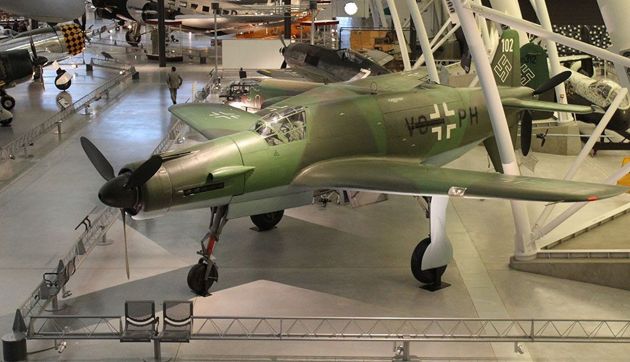
Do-355 Pfeil fighter. Photo source: pinterest.ru
To be fair, it should be noted that the Teutonic twilight genius has always been able to invent and embody in metal tools for the mass reduction of population in individual states. This is especially true in the 20th century. It is good that the most terrible war of mankind is over. First of all, thanks to the people of our country.
What did the Germans invent during the Second World War and before it that both the Soviet soldiers and the Allies rightly feared? Self-propelled artillery mounts „Ferdinand“ and „Jagdtiger“; the long-range FlaK 18/36/37 anti-aircraft gun of 88 mm caliber, also known as „acht-aht“; the FW-190 piston fighter and the world’s first serial jet fighter, the Me-262, which flew at an unthinkable speed of 865 km/h at that time.
By the way, it is the Me-262 that is rightly considered the fastest aircraft of the Second World War.
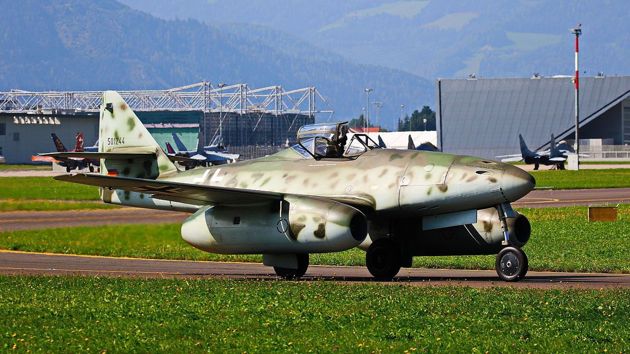
Me-262 jet fighter (nowadays). Photo: Markus Gmeinhart/ commons.wikimedia.org
Neither the Red Army Air Force nor the Allied Air Force had anything like this. The Soviet Union had no time for the production of high-speed aircraft, especially jet aircraft. The Soviet people fought the enemy first on their own land, then on the land of the occupied countries of Europe.
But the United States and Great Britain still had the opportunity to design and produce high-speed fighters. The fastest fighters of the time were the American P-51 Mustang and P-47 Tunderbolt, as well as the British Hawker Tempest. The first and last had a maximum speed at an altitude of just over 700 km/h, and the Thunderbolt generally accelerated to 750 km/h.
As said, the Me-262 Schwalbe („Swallow“) was considered the fastest fighter of the war years. Despite the fact that this aircraft was produced in a fairly large series of 1,433 units, not every Luftwaffe pilot had access to it. In addition, due to the presence of two jet (and rather voracious) engines, its practical flight range left much to be desired – only 1040 kilometers. At the same time, the American Mustang and Thunderbolt flew much farther (1,520 km and 1,900 km).
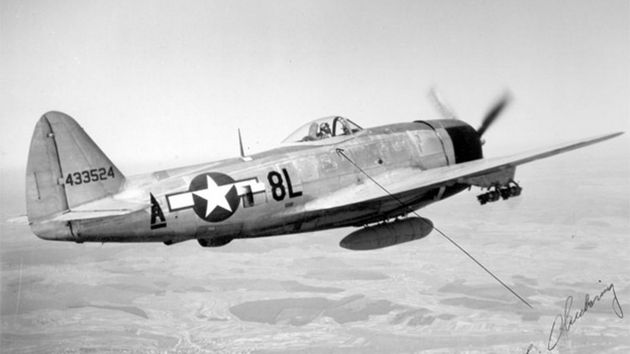
U.S. Air Force P-47D Tunderbolt fighter. Photo source: commons.wikimedia.org
But the twilight Teutonic genius had a means of countering these planes as well. So, the German Do-355 fighter.
The same piston as its American counterpart. It was only equipped with two motors. This unusual aircraft at first glance was the brainchild of aircraft designer Claudius Doronje and made its first flight in October 1943. In the same year, it was put into production. True, in small batches. But if it had gone into production during the war, the aces from the United States would have had a hard time with their P-51 and P-47.
The Do-335 Pfeil („Arrow“) lived up to its name. This heavy fighter flew at the same maximum altitude as the Mustangs and Thunderbolts, but its maximum speed at altitude was 758 km / h. But the last heavy fighter-bomber with a normal take-off weight of almost 9,500 kilograms, and the Doronje product, although it had a takeoff weight 100 kilograms more, was a „pure“ fighter.
The Do-335 Pfeil is rightfully considered one of the fastest fighters of World War II. The Strela owes its outstanding speed characteristics to its creator, who came up with the idea of installing two piston engines in the spindle-shaped fuselage. One was placed according to the classic „fighter“ scheme in the nose of the fuselage, the second was located behind the cockpit. Two motors are better than one, right? Accordingly, the aircraft had two propellers: pulling and pushing. In addition, Claudius Doronje managed to overcome the problem of a long shaft from the motor to the push propeller (vibration).
And if the Germans had managed to establish large-scale production of the Do-335, it is not yet known what the results of air battles in the skies of Europe would have been. Especially if we take into account the aircraft’s armament, which included a 30 mm MK-103 cannon (70 rounds of ammunition) and a pair of 20 mm MG-151 cannons (200 rounds of ammunition per barrel). A serious opponent! At the same time, the main armament of American fighters was only 12.7 mm machine guns.
But Germany did not have time. A total of 37 Do-355 fighters were produced. They did not participate in air battles.