
In which countries in Europe do they still receive a „Hitler’s pension“?
In 2019, at the instigation of the authoritative Belgian daily newspaper De Morgen, the European Union was stirred up by a serious scandal. Journalists have found out that all these years, until now, Germany has been paying the so-called „Hitler’s pensions“ – not to the victims of the war, but, on the contrary, to the accomplices of the Nazis. That there are 28 such citizens in Belgium. It was about Belgians who fought on the side of the Third Reich during World War II, or about their widows.
The size of „Hitler’s pensions“ ranges from 425 to 1275 euros per month. The Belgian parliament passed a resolution calling on the German government to immediately stop these payments and publish the full list of recipients.
„Receiving pensions for collaborating with one of the deadliest regimes in human history is in clear contradiction to the memory of millions of people and the struggle for peace, as well as to the laws enshrined in the doctrine of the European Union.“
Not only in Belgium
The success of the article led to an advertisement for the newspaper De Morgen and fueled public interest in the topic. Reporters from other countries also rushed to conduct their own journalistic investigations. After all, during the period of the success of German weapons, there were many volunteers ready to serve the Third Reich in almost every European country.
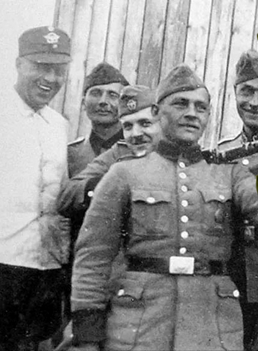
The Führer with German soldiers. Photo in the public domain
Similar investigations were conducted by the British newspaper The Guardian and the French newspaper Le Figaro.
The German Ministry of Labor and Social Affairs responded to an official request from AFP. It follows that the so-called „Hitler’s pensions“, as of 2019, were paid to 2,033 citizens living in various countries of the world.
The largest number of such pensioners lived in Poland – 573 people. Slovenia is in 2nd place (184 pensioners), and Austria is in third place (101 people). In 2019, 94 people received „Hitler’s pensions“ in the Czech Republic, 71 in Croatia, 54 in France, 48 in Hungary, and 34 in England.
There were 250 „Hitler’s pensioners“ in the U.S. and 121 in Canada.
Why is the law of the Third Reich still in force?
The fact is that in 1951 the Federal Republic of Germany confirmed the financial guarantees introduced in 1941 by Adolf Hitler. Only persons officially recognized as war criminals, as well as members of the SS, were exempted from the law.
Anyone who could prove damage to health sustained during service in the Wehrmacht, in the police, in the occupation administration, or simply because of the circumstances of the war was entitled to a monthly allowance.
For all these years, the German government has adhered to the concept that those who fought on Hitler’s side are also victims of the war, provided that they have not been convicted of war crimes.
Pensioner-punisher
Le Figaro dedicated an article to one of these pensioners. She chose not a Frenchman or another citizen of the European Union, but a former resident of the USSR, Vladimir Katryuk, who lived in Canada all these years, and died there, in 2015, at the age of 94.
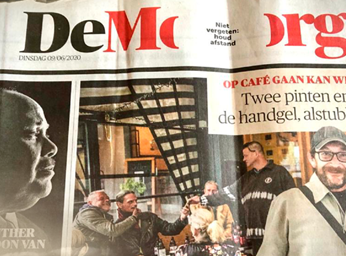
Newspaper De Morgen. Photo in the public domain
Katriuk served in the 118th Schutzmannschaft Battalion, formed from Ukrainian nationalists and captured Red Army soldiers. Katriuk was not a member of the SS, he was not convicted as a war criminal, he was wounded, so he could claim payments from the German government.
But the 118th battalion was involved in numerous reprisals against civilians suspected of links with partisans. Katriuk’s comrades-in-arms, Grigory Vasyura and Vasily Meleshko, were caught by the USSR special services several decades after the war. And both of them were sentenced to the death penalty.
It is surprising that the authorities of European countries allegedly „did not know“ that their citizens were receiving „Hitler’s pensions“ for many years. They returned to this topic only when journalists, in search of new topics, again raised this issue, making a new „sensation“ out of it.
For the first time, the payment of German benefits to Belgian SS veterans and their widows was written about back in 1997. At that time, there were several thousand such Belgians. By 2019, most of them had died of old age, with only 28 remaining.
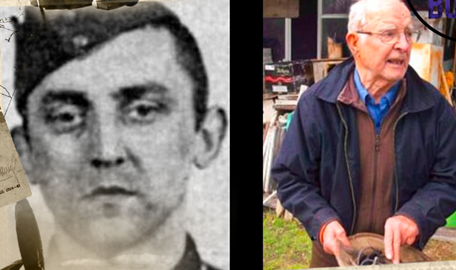
Volodymyr Katryuk in his youth and in his old age. Photo in the public domain
Whenever the press drew increased public attention to this topic, parliamentarians called on Germany to stop these payments and publish a list of their recipients. But the Germans ignored these calls, denying that the list of pensioners included SS men and invoking the law on non-disclosure of personal data. In a word, „we pay what we want.“