
Operation Barbarossa: German Calculations and Underestimation of the USSR
Historically, the Nazi plan „Barbarossa“ became an adventurous, but extremely dangerous „pinnacle“ of German military thought. The most ambitious and large-scale plan not only of the Third Reich, but also of the German Empire, which is the Kaiser’s.
After all, the concept of „lightning war“ has been developed since the second half of the 19th century. At that time, the Germans hoped to defeat both France and Russia, while avoiding a long war on two fronts. They say that first we smash France, then Russia (or vice versa, the „Schlieffen Plan“ was changed several times).
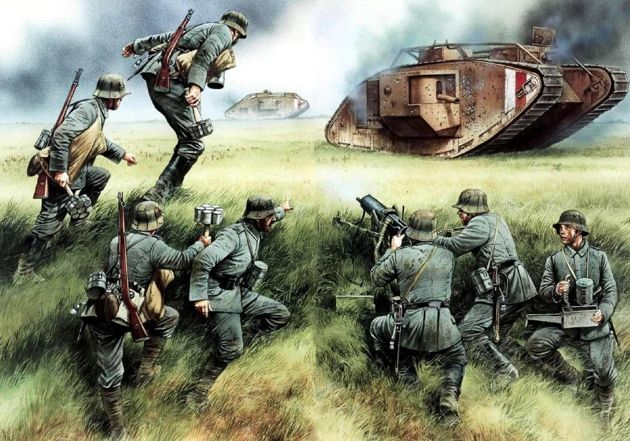
The German infantry, by the way, has not changed much in terms of weapons and tactics since the First World War.
They couldn’t, the technical potential didn’t allow it then. Later, in the interwar period, the idea of a quick defeat of the enemy (before he had time to use the resources of his country to the fullest) was combined with the method of using motorized units (and in general combining the actions of all branches of the armed forces).
With each new victory, the Nazis gained more and more „self-confidence.“ But it would seem that the USSR is not Poland or France.
The Nazis had several draft plans for the war against the Soviet Union (before the adoption of the final version, the plans were developed by E. Marx, B. Lossberg, F. Paulus, F. Halder, etc.).
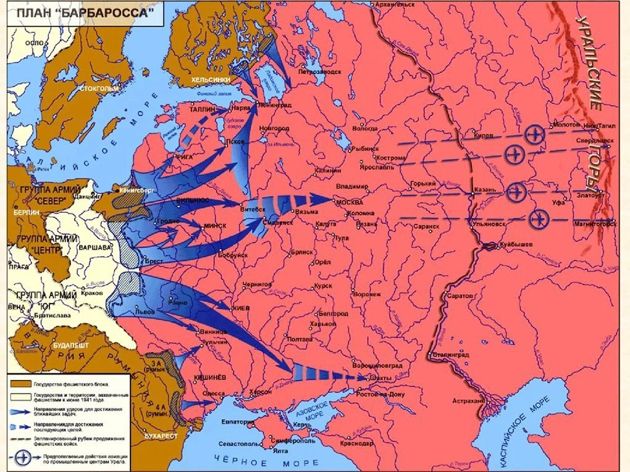
Despite the disputes, for example, about the directions of the main attack, these plans converged in many ways, showing a certain „stereotyped self-confidence“ of the Wehrmacht military leaders. Here are the most noticeable „common features“ (which personally „caught my eye“ when studying the topic):
First, the military (and politicians) of the Third Reich were convinced that „there would be no war on two fronts.“ This meant that Germany was in an advantageous position: it could use the overwhelming majority of its ground forces against the USSR without being distracted by France or Britain. At most, there will be a „front and a half“: England is weak on land, and can easily be held back by air and navy.
Secondly, for some reason, the Germans were sure that most of the Red Army’s forces would certainly be defeated in a „gigantic border battle.“ The last more or less combat-ready units were planned to be defeated near Moscow.
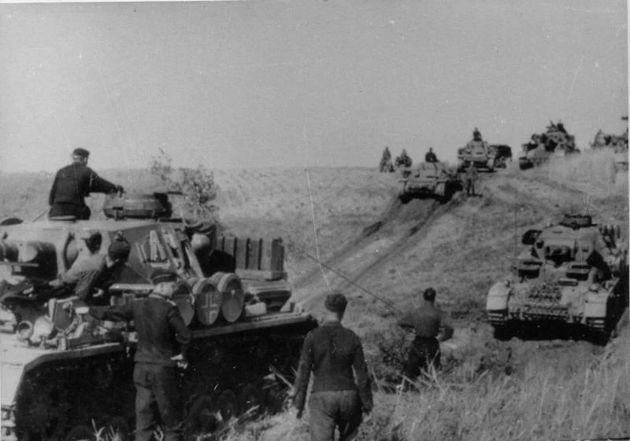
German tanks on the offensive during Operation Barbarossa, June 1941.
The Germans tried on the USSR the „patterns“ of their campaigns in Poland and France (only increasing the scale). For example, the possibility of a mass evacuation of Soviet industry to the east (and the deployment of new divisions)… almost didn’t look at it.
The Nazis rated the Red Army rather low, sometimes worse than the French Army (mainly the arguments for this assessment were 1937-1938, the Soviet-Finnish Army, or simply „we are better because we are Germans“).
Paradoxically, at the same time, the Germans actually did not have reliable data on the numbers, weapons, and equipment of the Red Army. Then we were very surprised, yes. Just as an „illustrative example“:
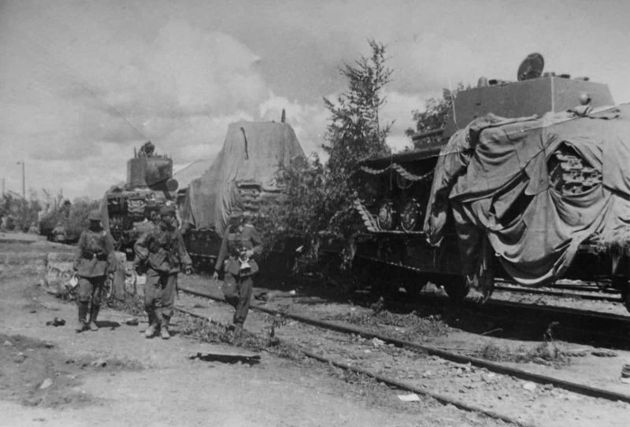
It’s an offensive photo. German soldiers at a train with Soviet KV-1 and KV-2 tanks captured on a stretch, July 1941. Unfortunately, the formidable KV tanks in 1941 were often left without supplies and were abandoned by their crews or captured in the echelons. In open combat, one such tank could fight an entire German unit, and it was very difficult to destroy it.In the summer of 1940, Field Marshal W. Brauchitsch stated, that the Red Army could field a maximum of 60 or 70 „decent“ divisions. And he offered Hitler… to attack the USSR in the autumn of 1940, what to expect (Auf antisowjetischen Kriegskurs. Studien zur militärischen Vorbereitung des deutschen Imperialismus auf die Aggression gegen die UdSSR. Lavrenov S. Ya. On the Continuity of German Military-Strategic Planning in the First Half of the 20th Century).
Finally, the last thing for today: the Germans did not even consider the option in which their „blitzkrieg“ would meet decent resistance and the situation would escalate into a protracted war of attrition (this is exactly what happened in the end, yes).
Hitler declared that the USSR was a „clay colossus“, the professional German military expressed themselves somewhat differently, but considered themselves and their army to be „the best“ (in terms of initiative, training of commanders, experience, etc.).
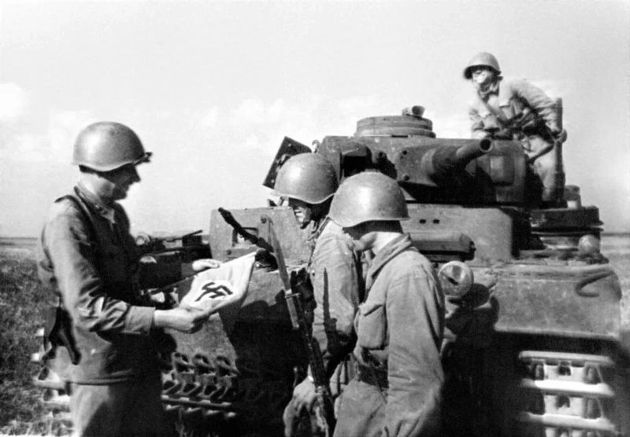
Red Army soldiers against the background of the German tank Pz.Kpfw. III Ausf. E, shot down near Mogilev, July 1941. Photo: Pavel Troshkin.
The expectation was that after the „border battle“ the Red Army units would lose control (maybe the state as such would collapse).
It is hard not to recall the White generals of the Civil War: if we strike at the Bolsheviks, their Red Army will collapse.