
Bloody Nights of 1937
Jagoda = berry Executioner of Russia.
He ruthlessly sent people to execution.
On March 15, 1938, Genrikh Yagoda was shot.
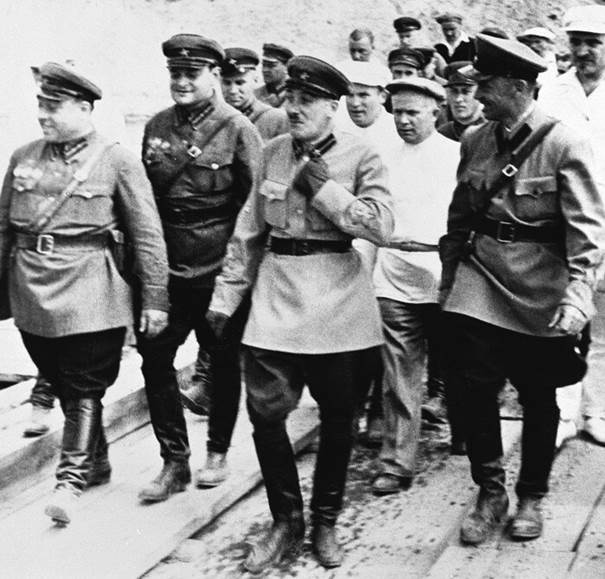
on the mausoleum, among the elite. Genrikh Yagoda. The second one is from the right. Very spectacular!
Hereinafter, the Author’s text is italicized.
Trotsky sarcastically called him a „zealous nonentity.“ However, he created a system that ruthlessly erased everyone. The revolution devoured its children. It’s like getting caught in a spider’s net. No pity or human involvement. They just executed people.
Who is he. The untalented son of a Jewish jeweler-engraver, who rose to power. Or a blood-sucking Vampire? … See!
A well-known biography of a sadist. Before the Revolution.
Genrikh Yagoda was born in 1891 in Rybinsk in the family of an engraver.
At birth he bore the name Enoch Yehuda, but later, when he converted to Christianity in order to live outside the Pale of Settlement, he Russified the name and became Henry Yagoda.
He owed his phenomenal ascent (for a man with his biography and a special lack of talents) to family ties. Yagoda’s father, Gershon, was a cousin of the father of the famous revolutionary family, Mikhail Sverdlov.
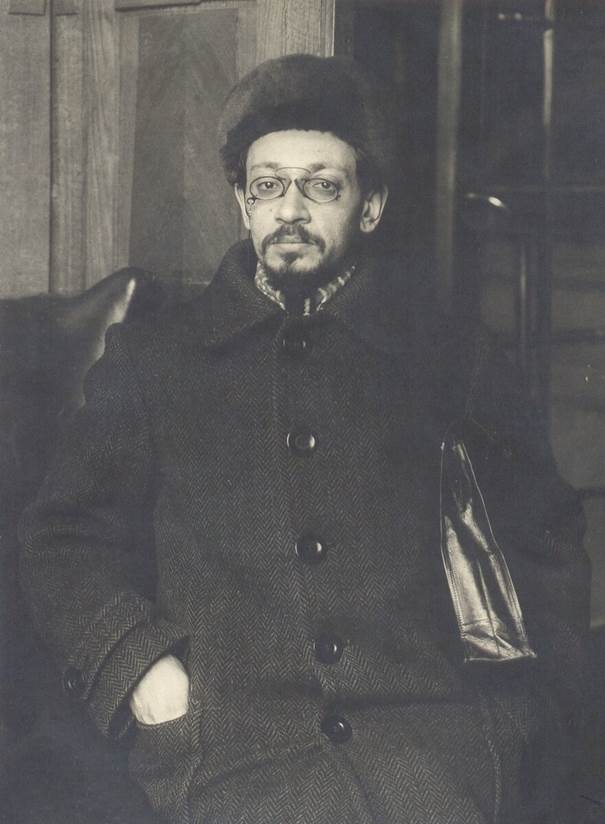
Sverdlov….
Politburo secretary Boris Bazhanov, who knew Yagoda, claimed that Yagoda worked as an apprentice to Sverdlov senior. And even robbed his workshop twice, taking away tools to open his trade. However, things did not go well and Yagoda had to turn himself back each time, after which he was forgiven in a kindred way.
This version seems to be true, given the close ties between the families and the fact that Yagoda’s father worked with Sverdlov. In the Sverdlov family, Yagoda met Yakov’s young niece, Ida Averbakh, who was 14 years younger than him. Many sources say that they married in 1915, but this is hardly possible as she was only nine years old at the time.
However. Let’s look at the gray cardinal of the Revolution. Sverdlov. Who is this? Everyone is saying something about this petrel of the Revolution. But. We don’t really know much. He was born, and it’s not interesting. But how did he end up in the Bolshevik cage?
It should be noted that the children of Movsha Izrailevich (father) were brought up in religious traditions. Yakov himself would later indicate „Jewish“ in the „Religion“ column in the gendarmerie department’s questionnaires.
It was surprising that, being completely insignificant in social, cultural, and financial terms, the Sverdlov family knew and maintained close relations with many influential and famous people of their era. First of all, this applies to Maxim Gorky.
… A version of the World Conspiracy. It seems that there is (there was) a group of ideological financiers whose task is to support and promote dissidents. Whose task is the collapse of Russia. Or is there something I don’t understand???
Let’s remember the wrestler Solzhenitsyn. Remembering Sakharov. Let’s remember Khodorkovsky.
But Gorky’s favorite was the eldest of the Sverdlov brothers, Zinovy. In the same year, 1902, Zinovy converted to Orthodoxy and received from Gorky, who became his godfather, his patronymic and surname – Peshkov. A couple of homosexuals, as it turned out.
Note- Upon learning of this, Movsha Izrailevich renounced Zinovy. Which is rare for Jews!
Italy, Capri, 1909-11, where the Petrel of the Revolution took refuge; Lenin, Dzerzhinsky, Krasin come to visit Gorky. Along the way, Gorky is the financial coordinator of the Russian Revolution. And they live there with Zinovy.
Let us return, however, to Sverdlov. In the criminal environment, the puny Yakov became Fortochnik.
He connected his abilities as an orator and organizer with the RSDLP, from 1903. Sverdlov became the organizer of the Bolshevik combat detachments. Oh, my!
Here, Yasha, in the guise of a bespectacled nerd, was the head of the militants‘ strike force
Novgorodtseva writes in her memoirs: „Yakov Mikhailovich carefully supervised the organization and training of the combat squad, the selection of militants. The vigilantes did not limit themselves to training in shooting, as before, but studied the tactics of street fighting, the technique of armed struggle.
Behold, it is the secret of the rise of an unknown uyezd Bolshevik.
Sverdlov was delivered to the Turukhansk region, to the Monastyrskoye village at the end of July 1913. After a while, another well-known Bolshevik, who had experience in criminal activity, Joseph Vissarionovich Stalin, also arrived here. This meeting in the remote wilderness of the Russian Empire was fateful for both revolutionaries.
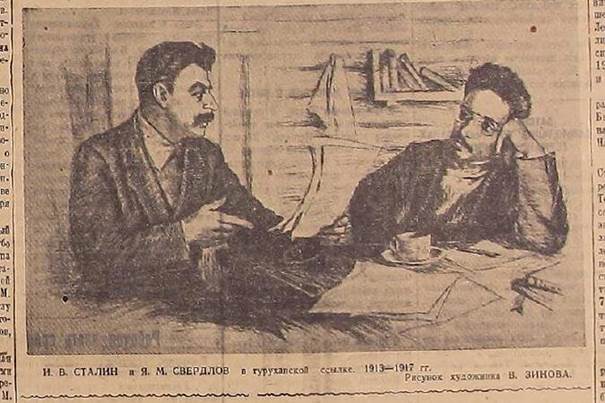
Well, let’s put an end to it. We are interested in Heinrich Yagoda, the unsuccessful engraver, Enoch Yehuda.
Trotsky sarcastically called him a „zealous nonentity.“
In 1918, Sverdlov became chairman of the All-Russian Central Executive Committee. In terms of his influence, he was the third man in the country. The first was Lenin, the second was the leader of the Red Army, Trotsky, and the third was Sverdlov, who de facto held the post of „president“ of the RSFSR. This was followed by a sharp rise of Yagoda.
With the help of Yakov Sverdlov, during Lenin’s lifetime, Yagoda became Dzerzhinsky’s second deputy. And after his death, he became the first deputy to the new head of the OGPU, Vyacheslav Menzhinsky. In addition, he headed the key secret political department of the OGPU, which was engaged in the fight against all internal political opponents of the party.
So. At the beginning of Perestroika, in one of the broadcasts, it was etched in my memory.
Comrade Stalin came with an inspection. First. In his presence, a special Ceremonial was observed. Ah, Yagoda allowed me to sit in his presence. Quite a demonstrative step. Showing. I’m the Boss here!
Henry’s gait is very confident. And who’s weaving there, in a cap. Yes, our old acquaintance, Kukuruznik Khrushchev.
PRO_engineers of human souls.
At the end of August 1933, Soviet writers led by Maxim Gorky took a trip on a steamer along the White Sea Canal. The result of this trip was a pathetic book, published in 1934 „The White Sea-Baltic Canal named after Stalin“, which glorified the re-education of prisoners by OGPU workers.
This kind of guide to the „Belomorstroylag“ was written by three dozen of the best writers of the Soviet Union, and its editor was Maxim Gorky himself.
Moreover, among the authors of the essays included in this work, there were many people who are portrayed, if not as opponents of Stalinism, then at least in their hearts who do not accept it.
And the list of thirty-six names is really the most curious: E. Gabrilovich, M. Zoshchenko, Vs. Ivanov, V. Inber, M. Kazakov, V. Kataev, A. Tolstoy, K. Finn, V. Shklovsky, A. Ehrlich, B. Yasensky, and, of course, Alexei Maksimovich himself…
In 1937, after the execution of the People’s Commissar of Internal Affairs Yagoda, who received the Order of Lenin „for the channel“ – his name was present on every page of the collective work – the book was banned.
It was withdrawn from libraries, destroyed, and today it has become a bibliographic rarity.
Conspiracy version… Yagoda is the head of the power bloc of the conspirators. The political leadership of the Central Committee of the Bolsheviks was divided into groups. And, in one of them was our „hero“.
Head of the Secret and Political Department of the OGPU, Head of the OGPU… Genrikh Yagoda.
People’s Commissar of Internal Affairs Genrikh Yagoda liked to live beautifully and allowed himself to relax, often in the 20s he drank with Rykov and the first secretary of the Moscow City Committee Uglanov. This beautiful life continued even after Yagoda became the head of the NKVD. For example, in the first months of 1936, several million rubles in gold were spent on all kinds of needs of Yagoda and his inner circle.
But soon the beautiful life came to an end. On August 22, 1936, Tomsky committed suicide. Before his suicide, Tomsky asked his wife to go to Stalin and tell him that People’s Commissar Yagoda was an ideological supporter of the Trotskyists and was covering up their illegal activities in every possible way.
Yagoda said to Artuzov. „With a device like ours, you won’t be lost. Eagles will do everything at the right moment. In no country does the Minister of the Interior dare to carry out a palace coup. And we will be able to do that, if necessary, because we have not only the police, but also the troops. Before the military knows it, everything will be done.“
Vernadsky’s secret diaries, published only during the period of perestroika, testify to the fact that this scientist was an ardent opponent of Stalin and knew about Yagoda’s opposition activities. The diaries mention a certain „accidental failure of the GPU-Yagoda to seize power.“
The head of the NKVD, Genrikh Grigorievich Yagoda (Enoch Gershevich Yehuda) was arrested on March 28, 1937.
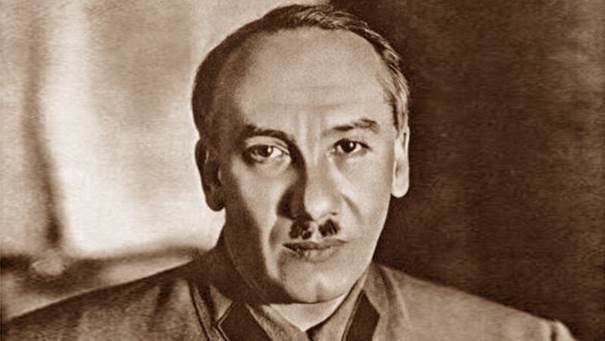
At a certain point, Yagoda, he said, under the influence of Bukharin and Rykov, „fell into a duality.“ „I did not have the Bolshevik courage to break definitively with the Rights, with this accursed counter-revolution, and to betray it in its entirety. Have there been any such attempts on my part? Yes, there were, but I never brought them to the end.“ „My downfall began when Rykov, having learned of my sympathy with the Rights, suggested that I conceal my Right views from the Party. And I went for it. I became a double-dealer. A dichotomy began. Unfortunately, I did not have the Bolshevik courage to resist the masters of double-dealing.“ At the same time, Yagoda, according to him, considered the opposition to be only „talkers“ who were not dangerous to the authorities, who could not count on the success of their counter-revolutionary deeds. Because he, as the former head of Soviet intelligence, who had his finger on the pulse of the whole country, clearly saw the hopelessness of any attempts to overthrow the Soviet government.
However, Comrade Yagoda-Sovramshi!!
On March 28, 1937, Yagoda was arrested, and an investigation into his case began. A. Kh. Artuzov reported on the following statements by Yagoda: „The main task is the restoration of capitalism in the USSR. It is quite clear, G. G. Yagoda noted, that we shall not build any socialism, that there can be no Soviet power surrounded by capitalist countries. We need a system that would bring us closer to the Western European democracies. Enough of the shocks! Finally, we need to live a calm and prosperous life, openly enjoy all the benefits that we, as leaders of the state, should have.“
On April 26, 1937, Yagoda admitted that he was going to arrest members of the Soviet government. At the investigation, Yagoda admitted that he had poisoned Menzhinsky, and was preparing a coup d’état together with Tomsky, Rykov, Yenukidze and Bukharin. Where can he go? His trump cards are beaten. When there’s a brute behind you, eager to see your blood, with a hook to hang by the rib. Defendant Yagoda chose an easy death for himself.
In the most responsible positions in the investigative bodies of the NKVD were Yagoda’s people, who were ready to launch an operation on his order – the ELIMINATION of Stalin: L. Zakovsky, S. Redens, M. Frinovsky and others. In this group of Conspirators I would like to mention the Man of Love and the Freedom of Love, Bukharin. In his previous article, Bukharin’s Suicide Letter. Bukharin, frankly, squirming, tried to jump off. I can imagine how Stalin laughed. He saw the situation by its beauty. In all its manifestations. There were also denunciations (and where without them), reports on external surveillance. Yes, a lot of things. And, here, Bukharchik is like that. It’s not my fault!! … They came of their own accord.
Bukharchik
Well, here’s what to say about these conspirators??? At the investigation, usually, when they already understand. What is the FCE. Masks are being removed. And so it is here.
VYSHINSKY: Tell me, traitor and traitor Yagoda, have you never felt the slightest regret or the slightest remorse in all your vile and treacherous activities? And now, when you are finally answerable before the proletarian court for all your despicable crimes, do you not feel the slightest regret for what you have done?
Yagoda: Yes, I’m sorry, I’m very sorry…
VYSHINSKY: Attention, comrade judges. Traitor and traitor Yagoda regrets. What are you sorry about, spy and criminal Yagoda?
Yagoda: I’m very sorry… I am very sorry that when I could have done this, I did not shoot all of you.
„I’m very sorry…. I am very sorry that I did not shoot you all!“ – these were Yagoda’s last words in court, before the shooting.
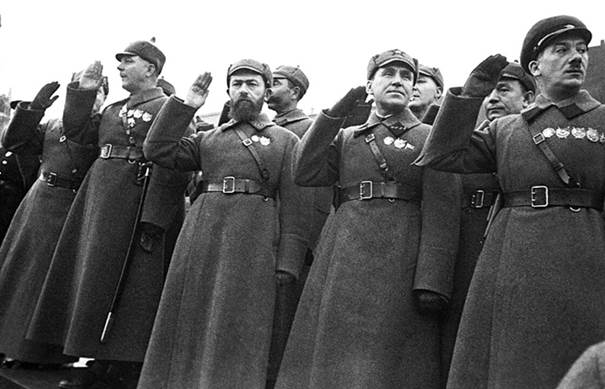
Among the elite. Berry. Where is he squinting his eyes?
There is one more piece of evidence (not very reliable, but interesting). Different people were put in Yagoda’s cell several times in order to talk to him and get new information. One of them, a certain Slutsky, reported that Yagoda, recognizing him as a „decoy,“ said: „You can write in your report to Yezhov: God does exist! From Stalin I deserved nothing but gratitude for my faithful service. And he deserved the severest punishment from God for having broken his commandments many times.
Now look where I am and judge for yourself whether there is a God or not…“
Retreat. In August 1937 there was a noisy trial of Zinoviev and Kamenev, which ended in their execution. And exactly a month later, Yagoda was removed from his post. And it was done in a very unusual way.
Stalin went on vacation to Sochi, where he discussed with Zhdanov the question of Yagoda’s removal.
After that, a note was sent to Moscow: „We consider it absolutely necessary and urgent to appoint Comrade Yezhov to the post of People’s Commissar of Internal Affairs. Yagoda clearly proved to be not up to his task in exposing the Trotskyite-Zinovievite bloc.
Nothing says anything better about a person. Than his stash.
After the arrest… Investigators found a luxurious collection of old wines (several thousand bottles) and an equally luxurious collection of pornography, which was crowned with a rubber penis (which was noted in the protocol), as well as a huge number of all kinds of fur coats, hats, hats, furs, antiques, a lot of other valuables and as many as three grand pianos. Of course, it doesn’t look so impressive now, but in the mid-hungry 30s, when even simple bread was a luxury, Yagoda’s wealth made an impression. Just a petty nonentity who has risen to power.
The denouement was terrible and bloody.
Cirkun. Memories.
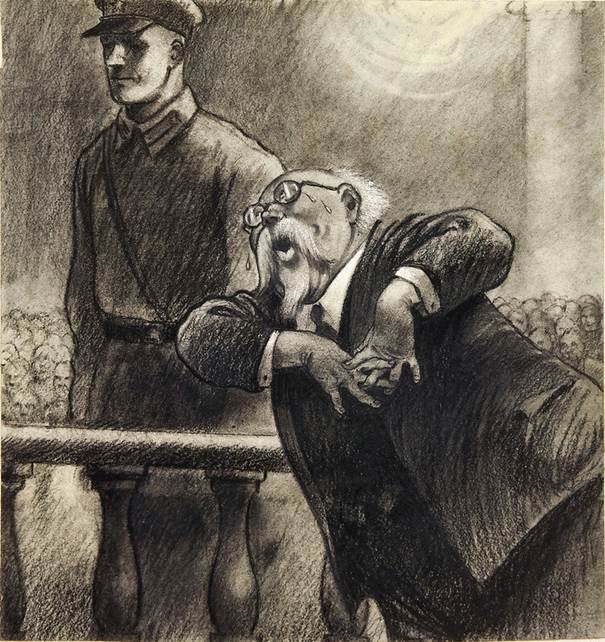
Yagoda was simply shot after long tortures. But no, he didn’t get off so easily. I wonder whose creativity it is: Stalin or Yezhov?….
Yezhov, but who knows if he would have dared to act arbitrarily? At 9:25 p.m., after hearing Yagoda’s last word, the court adjourned for sentencing. At 4 o’clock in the morning, its announcement began. Yagoda and 17 other defendants were sentenced to death and sent to the Inner Prison to await execution. Upon arrival at the prison, having received a piece of paper, he wrote on it: „To the Presidium of the Supreme Soviet from G. G. Yagoda, who was sentenced to V. M.
PETITION FOR PARDON
My guilt before my homeland is great. Without redeeming it in any way, it is hard to die. I am on my knees before all the people and the party and ask them to pardon me, sparing my life.
G. Yagoda 13.03.1938″. The next night they were allowed to spend in insomnia, waiting for death. Yagoda waited for the cell door to open and him to be led through underground corridors to the basement of the NKVD Motor Depot No. 1 in
Varsonofyevsky Lane, where death sentences were carried out during his reign.
But the day of March 14 came, and the convicts were still alive…
Late in the evening of March 14, in the dank twilight, the convicts were taken to the courtyard in front of the Inner Prison and placed in black trucks. The engines roared. Like the belly of a cannibal, the insides of the body were crammed with the cream of the Communist nobility, containing three former members of the Politburo, of whom Bukharin was also the head of the Comintern, and Rykov the Council of People’s Commissars, two former party leaders of the Union republics, two heads of republican governments, a former secretary of the Central Committee, and six Union People’s Commissars. They were buried like rotting waste in a garbage truck and slowly consigned to the dustbin of history.
The Chekists were not accustomed to stand on ceremony with their former colleagues who had been sentenced to death. I recall Agabekov’s story about how he led the former head of one of the Soviet prisons, Makhlin, to execution: „We went to Makhlin’s solitary cell. A narrow square room without any furniture. Under the ceiling there is a small window with a thick iron grille. Makhlin was sitting on the asphalt floor with his legs unshod. His boots were right next to him. When he saw us, he looked expectantly without getting up. Apparently, he still did not believe that he would be shot. He had hoped that the sentence would be overturned and was now waiting for us to inform him.
„Citizen Makhlin, the Central Executive Committee of the USSR refused to pardon you, so today the sentence of the court must be carried out. Do you have anything to pass on to your family and friends? I said.
For another minute he looked at me, as if he were taking in the words I was saying. Then his eyes went blank, and with the loss of hope, he sank like a punctured tire. He sat silently and did not move.
„So, there’s nothing to convey?“ „Well, in that case, get dressed…“
I left the cell and went to wait in the prison office. With his hands tied back, the Red Army soldiers threw Makhlin to the bottom of the truck. It must have been painful and uncomfortable for him to lie on the boards. But is he up to that now? He’s just a pile of meat now. What’s wrong with his bruises? In an hour he will be nothing.“
Probably, Yagoda was taken to his execution with the same comforts. If he had been able to see through the walls, he would have been surprised: a cavalcade of cars set off along the road well known to Yagoda, following the setting sun, towards the crimson and bloody sunset, towards death – to his dacha „Loza“ along the Kaluga highway. The truck was tossed on bumps, and from the darkness of its belly you could not see the sky with gloomy ragged clouds, tinted with crimson petals of the sunset. The suicide bombers, of course, understood what awaited them. Yagoda could well have remembered his words in one of his letters to Maxim Gorky: „How quickly we live, and how brightly we burn.“
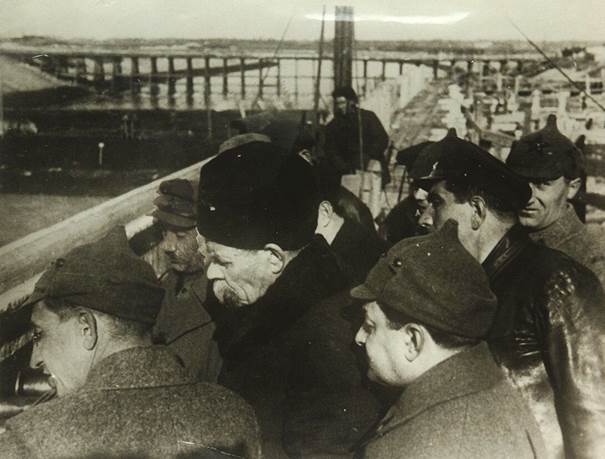
Gorky, in the center with Yagoda on the Belomora Baltic Canal
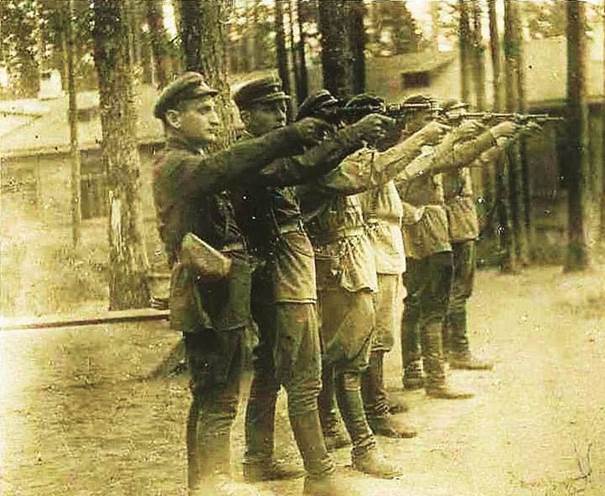
The darkness of an early March night met them in a forest surrounded by a fence and barbed wire. Once this forest was part of the Yagoda estate, but now it had to hide forever under its shadow the night lord of the Soviet empire. The convicts were taken out of the trucks and led along a linden alley to the building of the bathhouse, in the anteroom of which Yagoda once arranged a shooting range. Now he had to become a target in this range.
Bukharin once demanded executions, but here it is. On Yezhov’s orders, his former secretary Bulanov was the first to be dragged in and shot.
Then it was the turn of the others: they were taken into the room until two o’clock in the morning and killed one by one. Hryhoriy Grinko, a former Ukrainian Socialist-Revolutionary, who in 1920 joined the Bolsheviks and became one of the main organizers of the Holodomor as deputy People’s Commissar of Agriculture, was brought in and shot; for this, he was made People’s Commissar of Finance of the USSR and introduced as a candidate for the Central Committee.
Grinko, like other representatives of the communist elite, lived as a landlord, denying himself nothing. Here is a description of one of his saloon cars: „The doors of the compartment, bedroom and bathroom are mirrored on the inside, the interior trim is made of mahogany oak with varnish polishing, the ceiling of the cabin is upholstered with oilcloth, the walls are lined with cloth, the furniture is of a special design in mahogany, upholstered in shagreen fabric“
Comrade Grinko received a lot of good things from the Soviet government. All he had to do was get a bullet in the back of the head.
Isaac Zelensky was brought in and shot. In the past, he was a prominent figure, first secretary of the Moscow Party organization, secretary of the Central Committee and a member of the Organizing Bureau. In the autumn of 1923 he „overlooked“ the Trotskyist opposition, which had captured the votes of the majority of the Moscow party organizations, and for this Zinoviev and Kamenev transferred him to Central Asia. There he successfully survived these two persecutors. Now the time has come to shoot him as a Trotskyist.
An unremarkable employee of the People’s Commissariat of Agriculture of the RSFSR, he would hardly have found himself in such a select society. But in the minutes of his interrogation, where he was accused of „collecting secret information about the cultivated areas,“ there was a mention that in 1908 he was recruited by a certain bailiff Vasiliev as an agent of the tsarist secret police. This protocol caught the eye of Stalin in the next report, and he made a note: „Zubarev is a guard. Include in the list“, which decided the fate of this man. It was needed for color, to show the whole world how the former leaders of the Land of the Soviets, Bukharin and Rykov, came to be connected with an old agent of the Okhrana.
Vladimir Ivanov was brought in and shot. He was a major party official, a member of the Central Committee. His last position was People’s Commissar of the Timber Industry of the USSR. He was the supreme ruler of the logging mills, where tens of thousands of prisoners died. It was he, according to Yezhov, who recruited the above-mentioned Zubarev into the conspiratorial organization, thereby becoming a connecting thread between the tsarist secret police and Bukharin.
Akmal Ikramov and Fayzulla Khodjaev, the first secretary of the Central Committee and chairman of the Council of People’s Commissars of Uzbekistan, were brought in and shot
Ikramov called himself a „humanoid beast.“
Dr. Ignaty Kazakov was brought in and shot
This is one of the prototypes of Professor Preobrazhensky in „Heart of a Dog“ by M. Bulgakov.
In the 1920’s he put forward a bold doctrine in the field of experimental medicine—the artificial rejuvenation of the body by means of extracts from human embryonic cells. His experiments, of course, were of a secret nature, which brought him closer to Yagoda’s department. In the 1930s, he was appointed head of the Institute of Metabolism and Endocrine Disorders. The possibility of rejuvenating the body aroused the liveliest interest of the Kremlin leaders. Soon it became clear that Dr. Kazakov’s method gave only a short-term effect: the patient’s body constantly required a new dose of rejuvenating extracts, and the immune system could not withstand such interference and malfunctioned. The unfortunate doctor was declared a charlatan and accused of taking part in the „medical“ murder of Menzhinsky on Yagoda’s orders. In March 1938, his son was arrested in Saratov and sent to the camps for 10 years on charges of allegedly preparing the murder of Yezhov.
Nikolai Krestinsky, a prominent Trotskyite, one of the first members of the Politburo, and later a deputy of the People’s Commissariat of Foreign Affairs, was brought in and shot.
Stalin’s predecessor as Executive Secretary of the Central Committee (when Stalin was appointed, the position was renamed General Secretary). He had a twin brother, Sergei Krestinsky, a veteran of the Russo-Japanese War, who later served in the Ministry of Internal Affairs, then in the counterintelligence of Tsarist Russia. N. Krestinsky renounced his brother for ideological reasons; He was torn to pieces by an angry mob of revolutionary-minded deserters.
Pyotr Petrovich Kryuchkov, known in the literary and Chekist circles of Moscow under the nickname „PePeKru“, was brought in and shot.
As the literary secretary of M. Gorky, he was an agent of Yagoda under him. He was needed in order to accuse Yagoda of the murder of Gorky, allegedly on personal grounds (Yagoda was in fact in a love affair with the writer’s daughter-in-law).
Dr. Lev Levin (Usher-Leib Gershevich Levin) was brought in and shot.
Patient in the middle
Among his patients were V.I. Lenin and N.I. Yezhov, whom he tried to call on the phone when they came to arrest him. He had to meet his former patient here, in the dimly lit and cramped room of the Yagoda bathhouse, which smelled of damp wood and fresh blood. Yezhov watched as the doctor who treated him was shot, and Yagoda probably remembered the confrontation with Levin, which had been arranged for him in the winter, shortly before the trial. As a result, Yagoda was accused of instructing Levin, through his agent „PePeKru“ (Kryuchkov), to arrange the medical murder of M. Gorky and the chairman of the USSR State Planning Committee, a member of the Politburo, V. Kuibyshev. It must have seemed to Yagoda to be a greeting from hell that Frunze and Dzerzhinsky had given him. After Levin’s arrest, his son, who worked in the People’s Commissariat for Foreign Affairs, wrote a letter to Molotov asking him to intercede for his father; Molotov did not ignore the letter, putting a resolution on the letter: „To Comrade Yezhov. Why is this Levin still in the People’s Commissariat for Foreign Affairs and not in the NKVD?“
and Levin Jr. was arrested the same day and then shot.
Veniamin Maksimov-Dikovsky was brought in and shot. He headed Kuibyshev’s secretariat. According to the prosecution, it was through him that Yagoda organized the „medical“ murder of the latter. The details were apparently discussed at a closed meeting on March 9: perhaps they did not want to advertise that the office of a member of the Politburo was headed by an agent of the NKVD.
Arkady Rosengoltz, a former member of the Revolutionary Military Council, the Soviet plenipotentiary in England, because of whose espionage and subversive work in 1927 diplomatic relations between the two countries were terminated, was brought in and shot.
He selected workers for his apparatus by asking a single question at an interview: „How many counter-revolutionaries have you shot with your own hands?“
The former head of the Soviet government, Rykov, who suffered from alcoholism before his arrest (there was even an anecdote that Trotsky in exile made a will – in the event of his death, to alcohol his brain and send him to Moscow: to give the brain to Stalin, and the alcohol to Rykov), Frinovsky forced him to drink a glass of pure alcohol for the sake of amusement and shot him.
YAKOVLEV YAKOV ARKADIEVICH One of the organizers of the famine, after its successful implementation, he became the People’s Commissar of Agriculture of the USSR, a member of the Central Committee. Organizer of the All-Union Agricultural Exhibition (later VDNKh, now All-Russian Exhibition Center). During the trial, Soviet newspapers called him an „evil two-legged rat.“ His 23-year-old daughter Maria will be shot there, in Kommunarka, a month later, on April 21. His son died in 1942 in a Magadan camp.
Remains of the bathhouse. Here Bukharin, Rykov, Yagoda and others were shot
Vasily Sharangovich was brought in and shot.
Yezhov knew him well from many years of joint work in the Party Control Commission. Apparently, Sharangovich hoped until the last moment that Yezhov would not leave him in trouble. At the evening court session on March 12, Bukharin declared: „Citizen Prosecutor asserts that I, along with Rykov, was one of the greatest organizers of espionage. What is the evidence? The testimony of Sharangovich, whose existence I had not even heard of before the indictment.“ Sharangovich shouted from his seat: „Stop lying, at least once in your life! You are still lying in court.“ In his last words he declared: „Everyone like me will certainly be crushed by the whole might of Soviet power…“
Finally, there was no one left. Nikolai Bukharin, a former member of the Politburo and head of the Comintern, was lifted from his chair, led to a wall, and shot. Only Yagoda remained.
Yezhov ordered Dagin to give him a good beating before his execution: „Come on, give it to him for all of us!“ While Yagoda, powerless as a doll, was beaten, Yezhov and Frinovsky watched what was happening, enjoying the moment. Finally, limp under the blows, the almost senseless body of the former People’s Commissar fell helplessly to the floor… They put Yagoda on his feet, dragged him to the wall and shot him. The bodies of those executed were dragged out of the bathhouse with hooks and thrown into a trench dug nearby. Thus ended his earthly journey one of the People’s Commissars of Fear, and the other went to drink as usual…
And now let’s go back a bit, to the middle of the summer of 1937, when the Small Counter-Coup planned by Stalin and carried out by Yezhov was completed.
A powerful secret order of the NKVD, headed by Yagoda, which was half a step away from taking power over a huge country, was defeated.
Tsyrkun „Bloody Nights of 1937“.
… Here their corpses were dragged with iron hooks from the bathhouse to the trench. This land is soaked in the blood of Yagoda and other executed executioners.