
Education in the Third Reich. What were German children taught in school during the Nazi dictatorship?
Today, on May 12, at the UN Security Council, Russian Permanent Representative V. A. Nebenzya spoke about how the generation of young Ukrainians is being brought up today:
„I even took with me a geography textbook for the 8th grade, edited by Maslyak and Kapirulina. If he is to be believed, the ancestors of the French, Spaniards, Portuguese, Turks, and even Jews came from Ukraine. I want to address my French colleague: Nicolas, did you know that you are actually Ukrainian? Don’t believe me? Read the tutorial. It has an iron logic: since the ancestors of the French are Gauls, they came from Galicia.“
Speech at the UN Security Council by Russian Permanent Representative V. A. Nebenzya
With these words, the permanent representative stressed that the education system in our neighboring country has undergone total Ukrainization. I immediately had an analogy with the educational system in the Third Reich. After all, it is no secret that when Hitler and his party came to power in 1933, they relied on young people. So what were German children taught in school during the Nazi dictatorship?
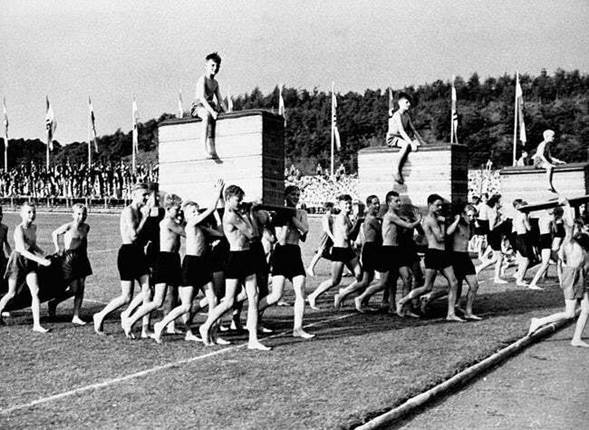
It is worth noting that priority in education was given to three subjects: history, physical education and singing. Physical Education: A true Aryan must be strong and enduring. Singing: learning patriotic songs and marches.
Sporting events.
History: The devastation in Germany after the First World War, the heavy burden of reparations payments that were required of it under the Treaty of Versailles, the country’s weak economy, the bitterness of defeat and the loss of loved ones all contributed to the emergence of revanchism and racism, which Hitler and his henchmen took advantage of.
A cult of race instead of biology lessons. A piano honoring Hitler’s youthful achievements instead of a history lesson. And the mathematics on which they calculated how to get rid of those who were considered subhuman was as cost-effective as possible. What else did the German school teach during the Nazi era?
„For more than a century, the German education system has been a model for the whole world. The German organization of education from kindergarten to higher education, the status of teachers, the nature of the curriculum; all of this has been widely recognized,“ Louis Snyder points out with obvious enthusiasm in the pages of the Encyclopedia of the Third Reich.
„From now on, your role is not to decide if something is true“
As early as 1933, Reich Education Minister Bernhard Rust declared: „From now on, it is no longer your role to decide whether something is true, but whether it is in the interests of the National Socialist revolution.“
The words were addressed to the teachers of the university. If honorary professors were expected to immediately become party propagandists, tens of thousands of primary and secondary school teachers were even more likely to fill this role. From that moment on, Nazism was to become the program of science.
Lessons at the Nazi School
As Richard J. Evans, in his book The Third Reich in Power, had portraits of the Führer in all the school rooms. Each lesson began and ended with a Nazi salute. Students were also regularly summoned to the gymnasium to listen to important political speeches.
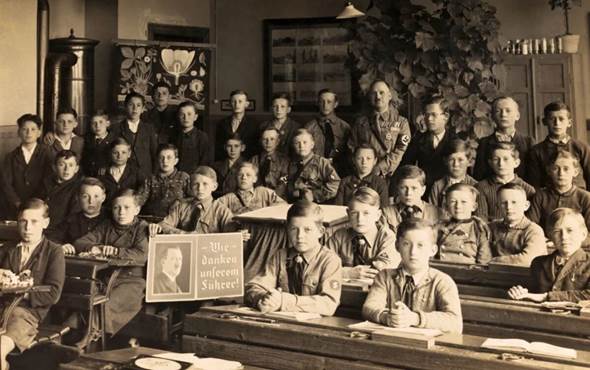
As early as July 30, 1933 (that is, only six months after Hitler was sworn in as Chancellor), the authorities issued a decree introducing the „Guidelines for History Textbooks.“
According to the document, science was to be based not on reliably presented facts of the past, but on „the concept of heroism in its German form, combined with the idea of leadership.“
School Themes in the Third Reich
Of course, the Kaiser’s and then Weimar’s schools had already successfully taught nationalism and covered up all the failures, embarrassments, and crimes of the Germans. Now, however, things have gone to the extreme.
The failed Nazi coup d’état of 1923 failed in a single day, and Hitler and his associates demonstrated extreme incompetence. Nevertheless, he quickly got into the curriculum: for students, the future coup was supposed to be a lesson in the highest patriotism. A Nazi apparatchik killed in 1930 in a dispute over non-payment of rent, Horst Wessel, in turn, was presented as a national martyr.
Finally, there were lessons in disgust for any opponents of Hitlerism.
Anti-Semitism from the Nazi School
The cult of the leader and blind hatred of non-Aryans were instilled in the children as soon as they left the kindergarten. The first textbook that every elementary school student had in his hands was the so-called ABC. On its cover is a disgusting caricature of a Jew, made in accordance with the worst stereotypes, with the caption explaining everything: „Don’t trust a single fox. Don’t believe any Jew!“
In biology textbooks one could read that „The animal world is divided into Nordic people and lower animals, the Jews.“ The lessons also proved that the Germans are the creators of culture and the Jews are the destroyers of it.
From geography books, students learned what „living space“ is, what blood and hard work are, and what the superiority of the Germanic peoples and their right to domination over their neighbors allegedly leads to.
On the walls of the classrooms hung maps depicting the idea encapsulated in the words „One Nation, One Reich.“ (Do these slogans remind you of anything? They are very similar to some theses of a neighboring country). And the teachers were told that the discussion of Middle Eastern topics was a good introduction to the „Jewish question.“
Nazi Mathematics
The new textbooks began to work even in mathematics lessons. For example, children were asked to calculate how much the state should pay for the maintenance of patients in psychiatric institutions. Of course, to show that it is simply unprofitable and unnecessary. And the students, for example, were tasked with counting how many blondes there were in Germany.
„The percentage of people with Nordic blood in the German nation is estimated at four-fifths of the population,“ said one task. „One-third of them can be considered blonde. According to these estimates, how many blondes will there be in the 66 million population of Germany?“
Homework in a Nazi school. Anti-Semitism and nationalism
The author of „The Third Reich in Power“ also cites a number of topics for essays that were given to German students in the mid-1930s: „Hitler as the Final Unification of Germany“, „The National Revolution as the Beginning of a New Era“. These are just a few typical examples.
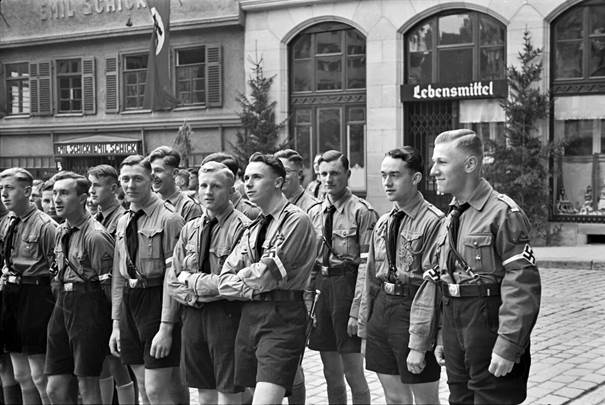
It was expected that the children would be able to prepare an essay praising the Hitler Youth, but also that they would skillfully resist any attack on the dignity of their nation.
Anti-Semitism at school, at home and on the street
There were also anti-Semitic themes. Irmgard Paul, author of My Nazi Childhood, recalls how he himself fell into the trap of school propaganda:
„We used a book that showed page after page the physical differences between Jews and Germans. There were grotesque drawings of Jewish noses, lips and eyes. The manual encouraged each child to pay attention to these differences.
I myself was horrified by the crimes of which the Jews were accused: the murder of children, usury, and conspiracies to exterminate Germany and take over the world. Such a description of the Jewish race managed to convince every child that he was reading about monsters and not about people like us.“
Similarly, Richard J. Evans presents the situation. He quotes a student who wrote that supposed subhumans are pests that need to be „exterminated.“ As well as a student who spoke about the situation before the arrival of Nazism in the following words:
„It was impossible to see a working Jew because all they wanted to do was deceive and deprive their fellow non-Jews of their hard-earned money. The Jews led the German people into the abyss. Those days are over now.“
„It’s hard for me to study.“ The Purpose of Nazi Propaganda and Indoctrination
Professor Evans stresses that the sharpness of the criticism was directed primarily against Jews from the East, that is, living in Poland or the Soviet Union. They were to be, according to Nazi doctrine, the most „dirty, dangerous, adulterous, and contaminated.“ They were, in propaganda, „enemies of all civilization.“ And German children blindly believed in this thesis.
This is exactly what Adolf Hitler dreamed of. As he stated in one of his radio appearances:
„My science is difficult. Every weakness must be eliminated by the strength of the young. Young people will grow up, and the world will shrink with fear at the sight of them. Ruthless, domineering, brutal, that’s what I want.“
Ideal candidates for future soldiers, ready to conquer, plunder and exterminate according to the Nazi vision of the world.