
What the Doctor Ordered: Goebbels’s Most Successful Propaganda Project
On January 14, 1930, during a domestic brawl, the young SA Sturmführer Horst Wessel was seriously wounded. For the Nazi Gauleiter of Berlin, Dr. Goebbels, this incident was a real gift…
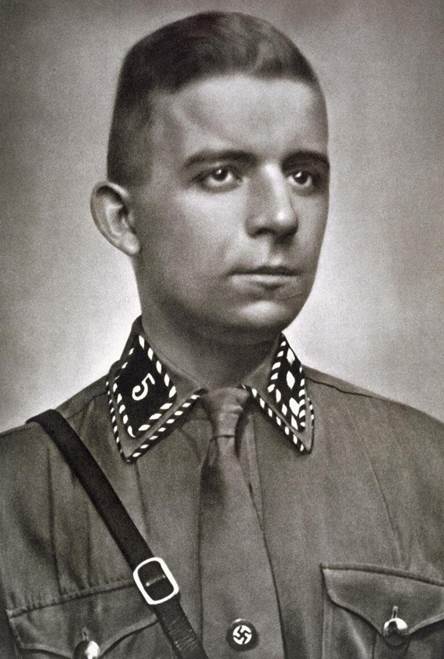
Horst Wessel
On the most ordinary and unremarkable Tuesday, January 14, 1930, an event took place in Berlin that had far-reaching consequences. At least for the history of the NSDAP. On that day, at about 10 p.m., during a domestic commotion, a prominent member of the Berlin Storm Troopers (SA), Horst Wessel, was shot. The fact that the murderer, an unemployed carpenter named Albrecht Höhler, was also a member of the German Communist Party (KPD), immediately gave the case a purely political tinge.
Despite his youth, by 1930 the 22-year-old Horst Wessel had managed to become a fairly prominent figure among the Berlin Nazis. Coming from a decent German family of an evangelical pastor, he hung out in Berlin’s beer pubs and was a member of various paramilitary nationalist organizations from his youth. In those days, it was considered fashionable among “advanced” youth. And the fanatical Wessel personified Röhm’s boundless stormtroopers better than anyone else. He constantly participated in street fights and messes with communists, organized attacks on Jewish shops, in general, he was a fascist. At the same time, please note, while studying at the law faculty at the prestigious Friedrich Wilhelm University…
But at the time, the Nazis had no power, so they had to constantly maneuver between the game of law-abiding and the brutal street lawlessness that distinguished the SA fighters. By the way, the assault on Wessel, in which there were about a hundred militants (SA-Sturm 5), was considered the most brutal in Berlin. Probably, because he had to operate in the most proletarian and “red” district of the city – Friedrichshain.
The craving for lawlessness of the future lawyer Wessel was so great that once he even rebuked the nominal Gauleiter of Berlin, Joseph Goebbels, with displeasure for restraining storm troopers. Goebbels angrily wrote in his diary:
… I’m in a quandary. If we become more active in Berlin, our people will blow everything to smithereens. And then Isidore will forbid us with a smile. First we must take power…
By “Isidore” Goebbels was referring to Bernhard Weiss, the stern head of the Berlin police who hated both the Nazis and the Communists, and who believed that both should be pinned down.
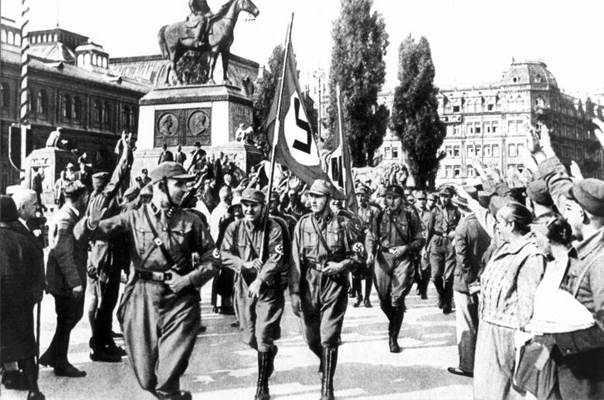
SA Sturmführer Horst Wessel (looking sideways) on the march at Nuremberg
To be fair, Wessel was known in Berlin not only for his fists and lawlessness. He also became famous in the literary field. Moreover, it was his writing talent that helped him gain a foothold in history. As if specially for his death, in October 1929 from the pen of Wessel came out the poems he formed into the song “Die Fahne hoch!” (“Banners up!”), which later became the anthem of the entire NSDAP until its death in 1945.
Banner upwards! The rows are tightly closed.
Assault squads march calmly with a confident step.
Comrades who were shot by the Rotfront and the reactionaries,
Invisibly marching in our ranks…
Why prophetic?
Judge for yourself…
Horst Wessel rented an apartment from the widow of a former member of the KPD in the working-class district of Friedrichshain. He did not live alone, but with his girlfriend, a former prostitute. At some point, Wessel delayed paying the rent for the apartment, quarreled with the landlady, and then, on principle, refused to pay rent at all. She immediately turned to her late husband’s friends, the militants of the militant wing of the KKE. the forbidden “Mouth of the Front” from Wessel’s poem…
On January 14, 1930, a group of “comrades” armed with firearms and brass knuckles raided the apartment of the fascist impudent man. When Wessel opened the door, a scuffle ensued, after which one of the attackers (Albrecht Höhler) shot Wessel in the mouth. He was taken to the hospital, where he died in agony a month later.
Vesel’s killer was soon caught and sentenced to 6 years in prison for “manslaughter”. In 1933, the Nazis who came to power took him out of prison, ostensibly to conduct an investigative experiment, took him to a nearby forest and shot him.
But all that would come later, and in those days only one person in Berlin realized the true propaganda potential of this incident. And that man was, of course, Goebbels…
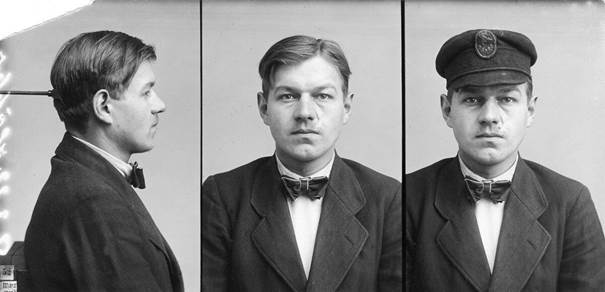
Horst Wessel’s murderer, Albrecht Höhler, immediately after his arrest in 1930.
While Wessel was still alive, they began to mold him into a martyr according to Goebbels’ patterns. In the Nazi and “well-fed” press, materials about his life did not leave the pages, of course, in the style of the “lives of the saints”… The song “Die Fahne hoch!”, as modern Internet users would say, was worn out to the holes, making it “viral”. Goebbels himself, on the day of Wessel’s death, published a long article in which he quoted the call from the SA song. It was then that it was decided to make it the official anthem of the NSDAP. The funeral was transformed by Goebbels into a gigantic political demonstration – the largest for the Nazis at the time. Alfred Rosenberg, having probably heard a lot of “Die Fahne hoch!”, wrote in those days that Wessel did not actually die, but joined a group of previously deceased Nazi “Kamarades”. Later, many fanatical Nazis would genuinely believe that all the dead were joining the “Wessel group” in heaven.
Amazingly, all of these events really hit the nail on the head. The death of the inveterate scumbag and street thug was a factor that significantly influenced the rise of the Nazi movement. In those days, the NSDAP was flooded with a large stream of Germans who had previously sympathized and hesitated and wanted to join the party “out of solidarity.”
The most interesting thing is that Hitler, unlike Goebbels, did not immediately understand the advantages of this incident. In general, he reacted rather coolly to this whole story. In those days, storm troopers were killed in fights with the Communists. Goebbels was never able to persuade the Führer to attend the funeral. Only 3 years later, on January 22, 1933 (a week before coming to power), Hitler visited Wessel’s grave for the first time…
By that time, his cult among the far right in Germany had already been inflated to unprecedented heights. If we draw an analogy with us, then he has turned into a likeness of our revolutionary heroes Babushkin or Bauman (older readers will understand this). In the Nazi party newspaper “Voelkischer Beobachter” he was called “Hero of the Brown Revolution” (truly brown, like that very substance).
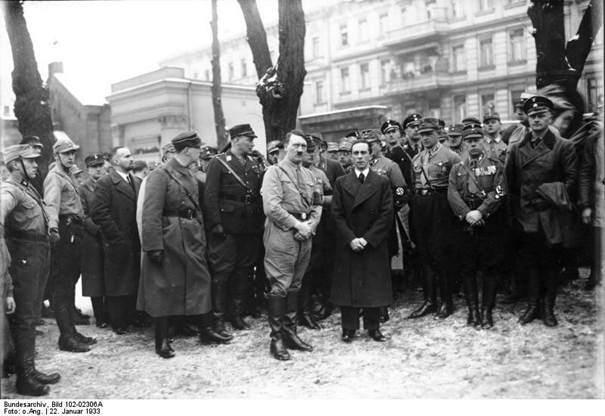
1933 Hitler and Goebbels at Wessel’s grave in Berlin
Until the very end of the NSDAP and the Reich, Goebbels exploited the cult of Wessel. It was on his initiative that members of the Hitler Youth shouted at the 1934 Party Congress:
We don’t need any Christian truth… We don’t follow Christ, we follow Horst Wessel!
This was Satanism in its purest form…
During World War II, Goebbels’ propaganda began to emphasize sacrifice from the “cult of Wessel.” As the Minister of Propaganda once stated, “to inflame millions of followers.”
And you know what?
They were really damn flammable. Especially in the Waffen-SS volunteer division “Horst Wessel”, formed in 1944, which was defeated and eventually surrendered to the Soviet troops. They were so ignited, so ignited.
Wessel’s artificial cult of street thugs did not survive Nazism and finally collapsed in May 1945, when Hitler, Goebbels, Himmler and others arrived in his “sky team”. His grave was destroyed and razed to the ground.